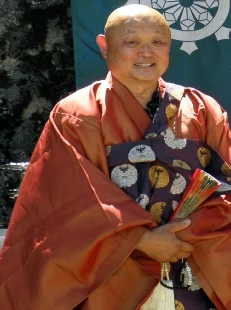
Reverend Koyo S. Kubose was born in Los Angeles, California. After World War II, he relocated to Chicago with his family. He earned a BA from the University of CA at Berkeley, a MA from San Francisco State University, and a Ph.D. in psychology from the University of Iowa. He was on the psychology faculties at the University of North Carolina (Greensboro), University of Hawaii (Honolulu), and University of Wisconsin Center System (Janesville). He went to Japan for three years and studied Shin Buddhism at the Eastern Buddhist Society at Otani University. He also did meditation practice under Zen masters Uchiyama Kosho of the Soto tradition and Kobori Nanrei of the Rinzai tradition.
Upon his return to the US in 1977, Reverend Koyo worked with his father, the Venerable Rev. Gyomay Kubose, a pioneer in the Americanization of Buddhism. From 1983 to 1995, Reverend Koyo served as a minister at the Buddhist Temple of Chicago, which his father established in 1944. Reverend Koyo was the president of Bright Dawn Center of Oneness Buddhism, which he established in Central California in 1996 to carry on his father's lifework. On April 4, 1998, Reverend Gyomay Kubose officially transmitted his spiritual authority to Reverend Koyo Kubose.
Reverend Koyo founded the Lay Ministry Program and continued to serve the community through various programs like Dial-a-Dharma and Live Dharma Sunday until his passing in 2022.
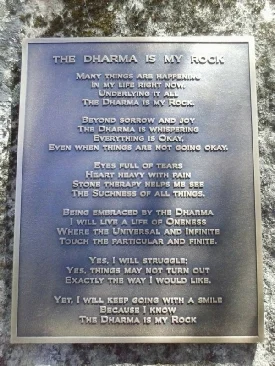
The Dharma Is My Rock
This poem is affixed to the side of Altar Rock, a location used for outdoor religious services.
Oneness Formula:
U = 2I + 2A = E
U = Right Understanding
2I’s = Impermanence and Interdependency
2A’s = Acceptance and Appreciation
E = Enlightened Living
In this formula, Oneness in life consists of Right Understanding which is the realization of the reality of Interdependency and Impermanence. To the extent these truths are experienced, the spiritual qualities of Acceptance and Appreciation are deepened, leading to what can be called Enlightened Living.
The Way of Oneness formula is intended to be universal. Although the formula comes out of a general Buddhist perspective, it is expressed in a way that hopefully makes it accessible to Buddhists of any sect, to followers of other religions, or even to those with no particular religious orientation. Persons from any tradition or approach could use their own terminology and illustrations to elaborate on the different aspects of the formula.
It should also be mentioned that of course life cannot be reduced to a formula. The Way of Oneness formula is simply a handy way to express some basic teachings about life. It is a nice summary that makes it easier to remember such teachings. To remember the teachings means to live them in one’s everyday life. This is the most important thing.